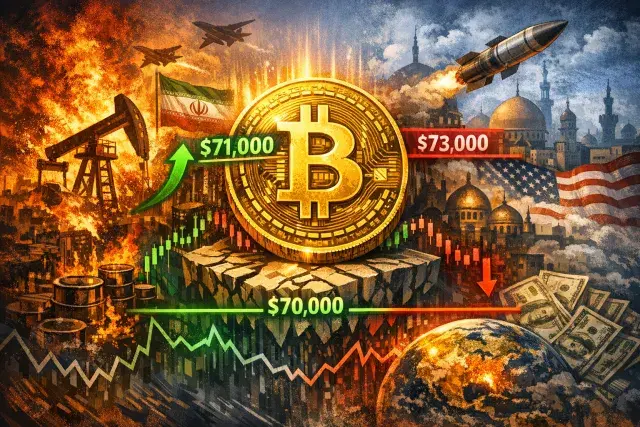
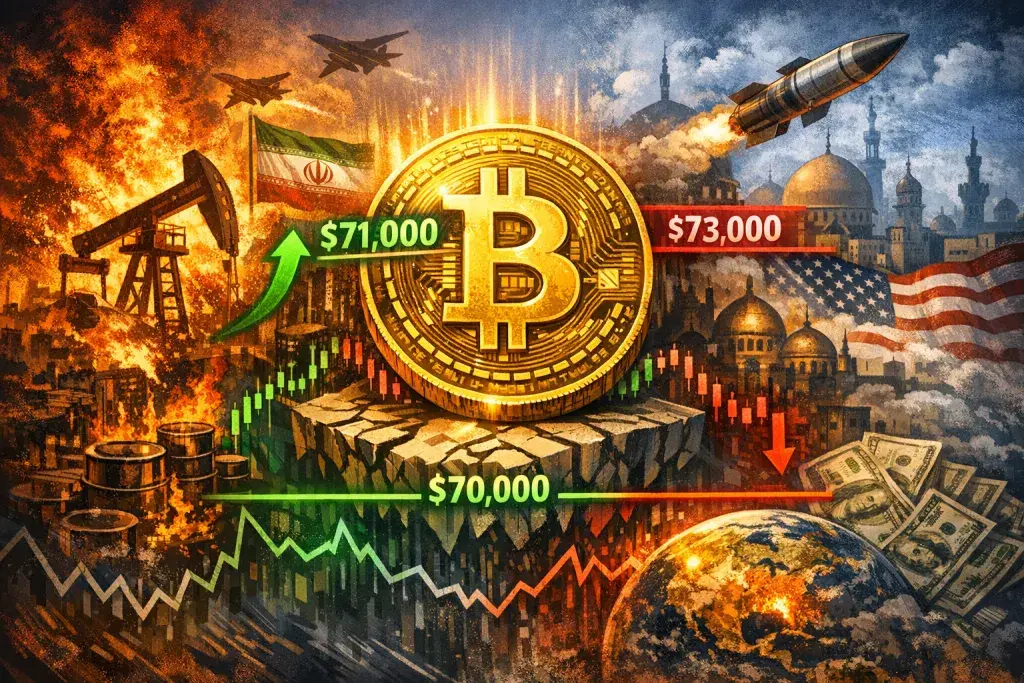
With oil prices climbing toward $99 and US-Iran peace talks teetering on fragile ground, Bitcoin has demonstrated notable resilience, trading at $71,897 — up 1.44% in 24 hours — as investors weigh the asset's role as an alternative store of value during periods of macroeconomic stress. The global crypto market cap rose 1.26% to $2.44 trillion, suggesting broad, if cautious, buyer participation. Whether that resilience holds depends heavily on what emerges from diplomatic talks in Islamabad and how energy markets respond.
The $70,000 Floor Is Holding — But the Ceiling Is Clear
Bitcoin's current position between two well-defined technical levels tells a precise story. Support at $69,000 to $70,000 has absorbed selling pressure through a week of geopolitical disruption, while resistance at $73,000 has so far turned back each rally attempt. Trading volume of $39.2 billion over 24 hours confirms that buyer interest remains substantive, not speculative froth. The market is not drifting — it is consolidating with intent.
Analysts at CoinSwitch Markets Desk described the current range as a deliberate pause rather than a reversal: macro news, they noted, will likely determine the next directional move. That framing is important. Bitcoin's price action is not being driven by internal crypto dynamics alone. It is responding to the same variables that move oil, equities, and currencies — a shift that reflects the asset's growing integration into institutional portfolios.
On-chain data adds a cautionary note. Whale wallets — long-term holders who accumulated Bitcoin in earlier cycles — reportedly offloaded approximately $271 million in BTC last week, the largest such weekly outflow from this cohort since January 10. A similar pattern in January preceded a 13% price decline. That precedent does not guarantee a repeat, but it warrants attention from anyone interpreting the current price as unambiguously bullish.
Oil at $99, Iran, and the Macro Forces Squeezing Crypto's Upside
Brent crude climbed to $96.75 and WTI to $98.91 after reported strikes on Gulf oil infrastructure reduced output by an estimated 600,000 barrels per day. If flows through the Strait of Hormuz remain restricted, analysts warn Brent could push far higher — a scenario that would have cascading effects across inflation expectations and central bank policy.
This is where the crypto market faces its most significant structural headwind. Rising oil prices feed directly into consumer inflation. Elevated inflation reduces the probability of near-term interest rate cuts. And rate cuts — or the expectation of them — have been among the most reliable catalysts for risk-asset appreciation, including Bitcoin, over the past two years. A sustained oil shock does not destroy the crypto thesis, but it delays the monetary conditions most favorable to it.
Compounding this, Iran's reported move to accept Bitcoin, stablecoins, and Chinese yuan as payment for Strait of Hormuz transit tolls introduces a geopolitically significant variable. Whether read as a sign of crypto's expanding real-world utility or as a regulatory risk trigger for Western markets, it has drawn attention to the asset class at a moment when institutional eyes are already watching carefully.
Altcoins Signal Selective Appetite — Hyperliquid and Solana Lead
Beyond Bitcoin, the market's internal structure shows differentiation rather than uniform movement. HYPErliquid (HYPE) rose 5.25% to $40.64, making it the strongest performer among the top ten assets by market cap. Solana added 1.44%, matching Bitcoin's gain, and the Solana-based meme coin CHILLGUY surged 25% — a signal that retail engagement is returning to riskier segments of the market, at least selectively.
Privacy-focused coins showed particular strength. Zcash rose 17.3%, trading above $370 with strong volume, and Dash posted comparable gains. This is a pattern with historical precedent: when regulatory tightening or geopolitical uncertainty rises, privacy-preserving assets tend to attract interest from participants seeking censorship-resistant transactions. South Korea's announced intention to tighten reporting requirements for transfers above 10 million won to private wallets may, paradoxically, have contributed to this dynamic.
- Bitcoin (BTC): $71,897 | +1.44% | Market cap $1.43 trillion
- Ethereum (ETH): $2,191 | +0.54% | Market cap $264.5 billion
- Solana (SOL): $83.10 | +1.44% | Market cap $47.7 billion
- HYPErliquid (HYPE): $40.64 | +5.25% | Market cap $10.4 billion
- XRP: $1.34 | +1.02% | Market cap $82.5 billion
Regulatory Signals Offer Longer-Term Confidence Amid Short-Term Noise
Several institutional and regulatory developments this week point toward a maturing market structure, even as short-term prices remain hostage to macro events. The US Treasury's cybersecurity office announced it will extend real-time cyber threat alerts to eligible crypto firms — the same service already provided to traditional banks. The move formalizes a layer of government-backed security infrastructure that institutional custodians and exchanges have long requested, and it marks a meaningful step toward treating crypto as a legitimate component of the financial system rather than a peripheral one.
Separately, a joint law enforcement operation involving the UK's National Crime Agency, the US Secret Service, and Canadian authorities froze over $12 million in criminal crypto assets and identified 20,000 victims of approval phishing scams across three countries. The operation also mapped more than $45 million in crypto fraud globally. Enforcement activity of this scale and international coordination signals that regulators are investing in the infrastructure needed to police the space — a condition that, over time, supports institutional participation rather than undermining it.
Dubai's regulatory authority published updated guidance for token issuers covering stablecoins and real-world asset tokens, adding another jurisdiction to the growing list of markets building formal frameworks. The near-term picture for Bitcoin remains defined by the range between $70,000 and $73,000, and by the outcome of talks that could shift oil markets, inflation expectations, and risk appetite simultaneously. What happens in the next 48 to 72 hours in Islamabad may matter more to crypto prices than any on-chain signal.